
Support without adding stress

worthwhile language advice
Have a question about language at work? You can send it to admin@worthwhileconsulting.com. All questions are anonymized.

“In two weeks, I am having major surgery to [address a very serious medical issue.] Then I’ll be out for at least 3 months on FMLA.
As part of the handoff for my work, I told my two closest co-workers what my surgery was for and why I’d be out for so long, I didn’t want them to feel like I was just leaving them in the lurch.
Now Anna, one of those coworkers, keeps on coming over to my desk and telling me how worried she is. She tells me how stressed out she is going to be during my surgery and wants me to text her right away to tell her how it went. She makes big sad puppy eyes when she looks at me.
All this is making me feel worse and I am kicking myself for telling them about my [medical condition]. Do you have advice on what I can say to Anna?”

It’s only human to be stressed out by other people’s stress, and to be made sad by other people’s sadness.
But Anna, like many others, is making a common mistake: she is asking you to handle her stress and sadness because it came from you. And that’s not fair or appropriate.
Anna is violating the simple principle at the heart of the Ring Theory. Let’s take a look.
The Ring Theory
A psychologist named Susan Silk was surprised by some of the tactless and irritating things said to her and her friends while they were dealing with major medical issues.
For example, when Silk told one of her colleagues she wasn’t up for visitors after breast cancer surgery, that colleague said, “This isn’t just about you.”
And when Silk’s friend Katie had an aneurysm, a friend of Katie’s came to visit, found her in rough shape, and then went out to the hallway and told Katie’s husband, “I don’t know if I can handle it.”
Both of these comments did more harm than good, even though the people making them were trying to show up and be helpful.
So to guide people who want to be supportive without adding to someone’s stress, Silk worked with her colleague Barry Goldman to come up with the Ring Theory.
How it works
This theory is pretty simple, and centers the person dealing with something difficult or traumatic.
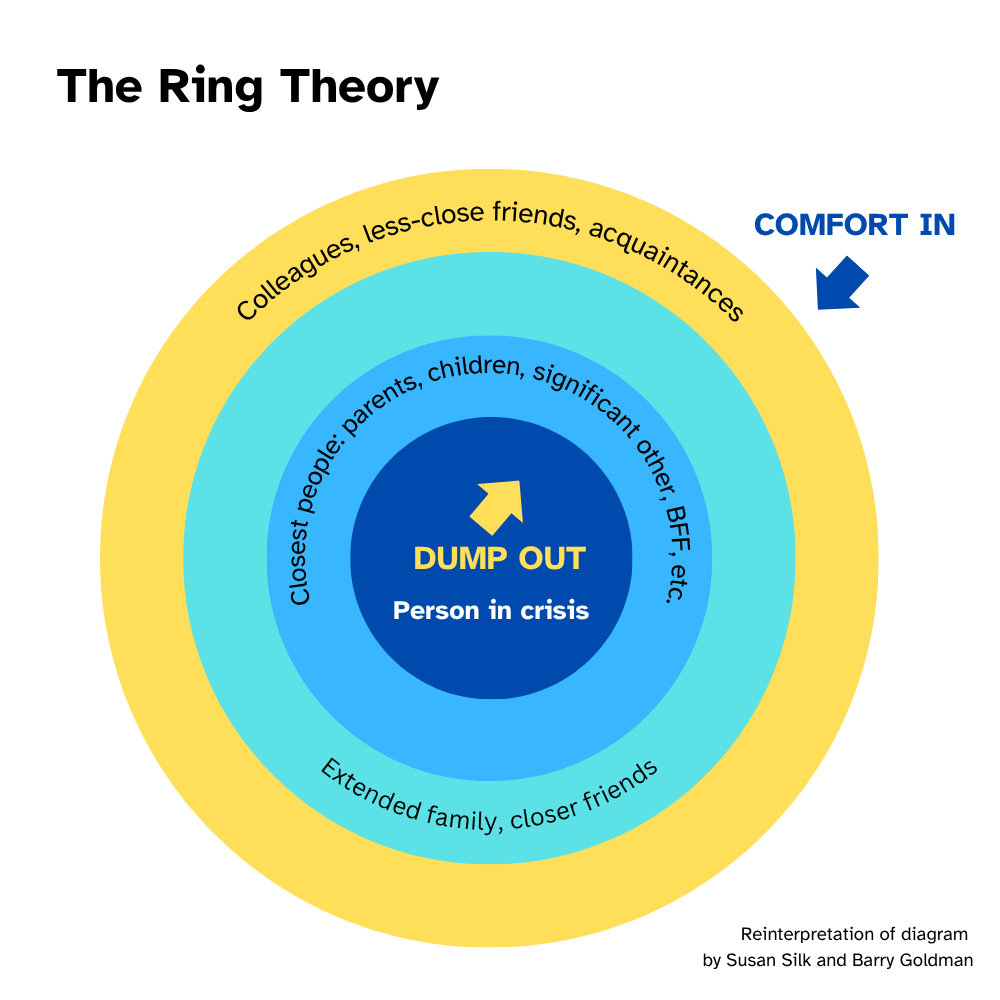
In the central circle is the person having a hard time. Let’s call them the PiC (Person in Crisis).
The next ring out is made up of the people very closest to the PiC, the ones who will be there by their side and doing the most caretaking. This might include a significant other or parent or child or lifetime friend. The PiC’s “inner circle.”
Next ring out from that is the PiC’s extended family and close friends.
And the outermost ring is made up of the PiC’s colleagues, friends who aren’t especially close, acquaintances, etc.
At the heart of the ring theory is the simple principle:
Comfort in, dump out.
In other words, you never say or do things to add to the stress of someone closer to the center than you are. You only say and do helpful things.
If you want to process or complain or lean on someone because you’re sad, you can talk to someone in the same circle as you or someone further out. Again, it’s only human to want to talk about your stress or sadness. This is why therapists have their own therapists.
Our goal is to avoid adding to the burdens of the Person in Crisis. Because their burdens are already heavy enough.
Is it comforting?
I think many of us struggle with what to say when someone tells us their bad news. It can feel awkward and overwhelming, and it’s hard to know what to do. How do we let the person in crisis know that we care? How do we make them feel better?
Here are two major traps to avoid:
centering yourself and adding stress
saying something that is meant to be comforting but isn’t.
Centering the wrong person:
“I can’t stop worrying about you.”
“I know exactly how you feel.” (Said by someone who has not gone through anything remotely similar.)
“You have no idea how hard it is for a parent when their child is in the hospital.” (Said by parent to hospitalized offspring.)
And a few examples of comments that probably won’t feel comforting:
“Everything happens for a reason.”
“They’re in a better place now.”
“You need to be strong.”
“I’m sure everything will be alright.”
More helpful:
“That sounds really rough, I’m sorry.”
“If you need to vent or complain, I’m happy to listen.”
“I’m thinking about you and wanted to check in. Let me know if you’d like company, or if there’s something I can do.”
What can you do?
Let’s circle back to the question that started us off.
Reader, what you need is for Anna to learn about and apply the Ring Theory.
Unfortunately, getting her this information is just adding to your burdens. Because you have to decide:
If I tell Anna directly that what she’s saying is bothering me, will she take it well? Can she handle constructive feedback? Or will it damage our relationship?
Is there someone in an outer ring I can trust to get Anna this information in the right way? Like [second coworker]?
It is unfair that you have to do emotional labor to manage your colleague while you are also building yourself up to face some genuinely scary medical stuff.
As you undergo your medical procedure and recover, it is time to center and focus on yourself. Don’t worry about managing other people’s stress and emotions.
Because it is incredibly common to be well intentioned but say the wrong thing. Hopefully, as more of us learn about the Ring Theory and what not to say, we can do a better job of supporting the people around us who are having a hard time.
Copyright 2026 © Worthwhile Research & Consulting
Do you hear communicators, executives, managers, or HR staff asking, “Is it ok to say that?” Could your organization use some guidance when it comes to what language is or isn’t acceptable?
Worthwhile offers Language Guidance consulting packages. You can buy Dr. Wertheim’s expertise in bundles of 10 or 20 hours. Then, whenever you have a question on “Is it ok to say that?”, reach out and get a science-based answer and supporting explanation that lets you move forward with confidence.
Email admin@worthwhileconsulting.com to learn more.